Barclays US
- 4.6
- Rating
- 1.00M
- Installs
- Free
- Price

 Analysis by App-foxy
Choosing a finance app is less about finding the one with the longest feature list and more about finding the one that fits the way you already handle money. I spent time with Barclays US as a mobile banking companion, paying attention to everyday tasks rather than treating it like a glossy product demo. My overall impression is that it is most useful for people who already use Barclays US and want a practical way to stay connected to their accounts, rather than for someone searching for a complete household budgeting system.
Barclays US is a free finance app from Barclays US, with an Everyone age rating. It has built a strong presence on mobile, with over a million installs and a 4.7 average from around 52 thousand ratings. Those figures suggest that it is not a niche experiment, but popularity alone should not decide whether it belongs on your phone. The better question is whether its account-management approach matches your needs.
What I looked for before recommending it
My first decision criterion was routine usefulness. A banking app should reduce small points of friction: checking whether a payment has cleared, reviewing recent activity, keeping an eye on an account, or handling a task without opening a desktop browser. Barclays US makes sense when those moments are central to your financial life.
You May Also Like

 Blood Strike: 2.5 Anniversary
Blood Strike’s Loadouts Turn Every Drop Into a Tactical Gamble
A close look at Blood Strike’s custom loadouts: how fast access to signature weapons reshapes its battle royale rhythm, rewards preparation, and narrows the gap between fights.

 Pandora - Music & Podcasts
Pandora’s Music Is Easy to Start, but Harder to Recover
Pandora’s strength is its low-effort path from a seed to a station. Its weak spot is how much confidence it asks you to place in connection, setup, and quiet recovery.

 8 Ball Pool
 Is Built on Rivalries, Rematches, and Routine
A close look at the rivalries, rematches, shared routines, and unanswered safety questions that turn a quick pool match into a persistent mobile community.

 Samsung Music
’s Quiet Strength Is Playing What You Already Own
Its reach comes less from spectacle than from dependable access to a personal library. That simplicity is both the app’s strongest retention engine and its ceiling.

 AccuWeather: Weather Radar
AccuWeather Review: A Quick, Clear Forecast for Everyday Decisions
For everyday plans, the best forecast is the one you can understand quickly. AccuWeather makes rain timing, radar, and local conditions easy to act on, with a few trade-offs.

 Hill Climb Racing
Why Hill Climb Racing Still Turns Crashes Into One More Run
A tiny car, a bumpy hill and one more upgrade: Hill Climb Racing keeps resurfacing because its simple chaos makes every near-miss feel personal.
More From Our News Desk



The second criterion was focus. I do not expect a bank-specific app to replace a dedicated budgeting service, a spreadsheet, or a broad financial dashboard. I look instead for a clear connection between the app and the institution behind it. In this case, the developer is Barclays US, so the app’s main value comes from putting that relationship into a mobile format.
I also considered how much effort it takes to adopt. A free app can still be expensive in time if it requires a new account, a new money-management habit, or repeated manual work. Barclays US is easier to justify for an existing customer than for somebody who would need to change their primary financial setup just to use it.
Finally, I looked at what happens when the app is not enough. A useful finance tool should fit into a wider routine, whether that means using another service for spending analysis or relying on a browser and customer support for less common needs. The strongest choice is not always the app with the most functions; it is the one that leaves the fewest awkward gaps in your particular workflow.
The everyday check-in
One realistic use case is a quick morning account check. Before paying a bill or making a larger purchase, I want to see recent activity and understand what money is already committed. A bank app is valuable here because it keeps that check close to the account itself, instead of asking me to reconstruct the picture from email alerts, paper statements, and a separate budgeting tool.
I found this kind of short visit more convincing than the idea of spending a long session inside a finance app. Barclays US works best as a place I can open with a specific question: has a transaction appeared, is the balance where I expect it to be, or do I need to review activity before moving on? That focused use is a strength, especially for people who dislike complicated financial dashboards.
Where Barclays US fits particularly well
The clearest advantage is the direct relationship with Barclays US. If your financial products are already connected to that institution, a dedicated app is usually more sensible than trying to force everything through a third-party aggregator. You avoid maintaining another layer whose main job is to pull information from somewhere else.
That directness also makes the app easier to understand. Instead of presenting a broad picture of every account you have, it is centered on the Barclays US side of your finances. For a user who wants a dependable place to check that relationship, this narrower scope can feel calmer than an all-in-one money app filled with categories, charts, and accounts that are not relevant to the current task.
Another strength is the low financial barrier. The app is free, so the decision is mainly about compatibility and usefulness rather than a subscription calculation. That matters for someone who wants mobile access without adding another recurring expense to a financial routine that may already include several services.
The app’s long availability also gives it a sense of continuity. It was released on February 16, 2012, and the current version is 8.6.0. I would not treat age as proof that every interaction is perfect, but continued development is reassuring when the app is connected to something as important as personal finances.
A practical workflow I would use
I would use Barclays US in three short stages. First, I would open it before a planned payment or purchase and review the latest activity. Second, I would compare what I see with my own expectation, such as a recent payment or a transaction I recognize. Third, I would close the app and record only the information that matters in my broader budget, rather than repeatedly checking without a purpose.
That last step is easy to overlook. A bank app shows the institution’s view of your account, but it does not automatically become a complete spending plan. I would not use a current balance as permission to spend every dollar shown there, because pending activity, upcoming commitments, and goals outside the account can change the real picture. The app is strongest as a source for account awareness, not as a substitute for financial judgment.
A second useful habit is to separate monitoring from analysis. I would use Barclays US to verify account activity, then use a spreadsheet or a budgeting service if I wanted to compare categories over several months. This keeps each tool responsible for the job it handles best and avoids expecting a bank-specific app to become a full financial command center.
Where the focused approach can feel limited
The same focus that makes Barclays US straightforward may disappoint users who want one screen for their entire financial life. If you have accounts at several institutions, investments, household expenses, or detailed savings targets, a dedicated aggregation or budgeting app may give you a broader view. That does not make Barclays US poor; it means its boundaries matter.
I would also be cautious about choosing it purely because it is highly rated. Around 6.7 thousand written reviews and a 4.7 average are encouraging, but ratings cannot tell me whether the app suits a person who needs advanced planning, shared household tracking, or a detailed spending history. A strong general response is useful context, not a replacement for matching features to your own routine.
Another point of friction is the possibility of switching between tools. If you want to monitor Barclays US accounts alongside unrelated accounts, you may end up opening more than one app. That is manageable for a simple setup, but it becomes tiring when your financial decisions depend on a complete picture. In that situation, an aggregator may be more convenient even if Barclays US remains the better place to view the Barclays relationship itself.
There is also a difference between mobile convenience and complete service access. A phone is excellent for quick checks, but some complicated financial tasks are easier to understand on a larger screen or through a more deliberate support process. I would not assume that a mobile app should be the only channel for every unusual request. Keeping a browser or another official contact route available is sensible, particularly when the issue involves more than reviewing routine activity.
Who should choose it, and who should look elsewhere?
I would recommend Barclays US first to an existing Barclays US customer who wants a free, direct mobile connection to their accounts. It is also a reasonable fit for someone who values quick account checks over elaborate financial visualization. If your main question is “what is happening with my Barclays account right now?”, the app is pointed at the right problem.
I would be less enthusiastic for a person who has no Barclays US relationship and is comparing finance apps solely for budgeting. That user may get more value from a tool designed around multiple institutions, shared expenses, category analysis, or long-term planning. Installing a bank-specific app without using its underlying banking relationship would not make much sense in that case.
Families should think about their workflow before deciding. If one person manages a Barclays US account and only needs personal access, the focused design may be convenient. If several people need a shared overview across different banks and cards, a broader household finance tool could reduce the number of places everyone must check. The better choice depends on whether direct account access or shared visibility is the priority.
People who are highly security-conscious should use the app carefully in the same way they would use any financial service on a phone. I would install it through the official store, keep the device protected, avoid signing in on unfamiliar networks when practical, and review activity regularly. Those habits do not make the app inconvenient; they make mobile banking less dependent on luck.
Comparing it with the usual alternatives
Compared with a desktop banking website, Barclays US is more convenient for short checks because a phone is usually nearby. The trade-off is that a desktop browser can feel better for reading a lot of information, comparing records, or handling a task that needs more space. I see the app and website as complementary rather than competing choices.
Compared with a general budgeting app, Barclays US offers a more direct path to the Barclays US side of your finances, while the budgeting app may offer a wider cross-account picture. A budgeting service is the stronger option when categories, trends, and combined household data drive your decisions. Barclays US is the stronger option when direct account awareness is the immediate need.
Compared with a spreadsheet, the app is faster for checking current account activity, while the spreadsheet gives me more control over custom planning and historical organization. I would not replace one with the other automatically. A useful combination could be the app for verification and the spreadsheet for decisions, provided I am willing to maintain the manual side.
Compared with relying on notifications or statements alone, the app gives me a more deliberate place to review activity when I choose. Notifications can be helpful reminders, but they are not always the same as sitting down and checking the account context. I would still avoid turning every alert into a reason for anxiety; a planned review routine is usually more useful than constant checking.
The real cost of changing your routine
Because Barclays US is free, the main switching cost is not a subscription. It is the time spent learning where the app fits and deciding which other tools remain necessary. If you already bank with Barclays US, the change may be small: install it, sign in, and build one or two purposeful check-ins into your routine.
If you are moving from a website-only habit, the adjustment is mostly behavioral. The temptation is to check more often simply because access is easier. I would resist that and define a few useful moments, such as before a large purchase or during a weekly money review. Convenience works best when it supports a plan rather than creates another source of distraction.
Switching from a broad budgeting app is more complicated. You may lose the single combined view that helped you understand spending across institutions, even if Barclays US gives you a better direct connection to one account. Before changing, I would write down the tasks I perform in the current app and mark which ones Barclays US can replace. That simple test prevents a familiar mistake: confusing a good banking app with a complete budgeting system.
Switching away from Barclays US can also create unnecessary work if the app already handles the part you need well. I would not move just because another finance app has more colorful charts or a longer feature list. If the current app lets me answer my important account questions quickly and reliably, extra complexity may not improve my financial decisions.
Version, access, and day-to-day expectations
The current version is 8.6.0, and the minimum operating-system requirement is iOS or Android 12. That requirement is important before installation: users with older phones may need to update their device or use another access method. I would check the phone’s operating-system version first rather than discovering the compatibility issue after planning around the app.
The Everyone rating makes it broadly suitable from an age-classification perspective, but financial responsibility still matters. A young or inexperienced user may need guidance about balances, payments, and account security even when the app itself is age-rated for everyone. The rating describes access suitability, not financial education.
I would also keep expectations realistic around updates. A newer version can improve the experience, but it does not change the app’s basic role as a Barclays US finance tool. If your reason for installing it is detailed investment analysis, multi-bank planning, or comprehensive budgeting, a version update should not be expected to turn it into a different category of product.
My recommendation after using it
My recommendation is straightforward: choose Barclays US when you are already a Barclays US customer and want direct, free mobile account access. Its best quality is not that it tries to do everything. It is that it gives the Barclays relationship a practical place on your phone, making routine checks easier and more immediate.
I would pair it with a separate budgeting method if I needed category-level analysis, long-term planning, or a combined view of accounts elsewhere. That could be a spreadsheet, a general budgeting app, or simply a regular written review, depending on how much structure I want. The important thing is to recognize the division of labor instead of blaming Barclays US for not being a product it was not designed to replace.
I would skip it as my primary choice if I do not use Barclays US, if I need a shared multi-bank household dashboard, or if my main goal is detailed financial planning rather than account access. In those situations, a broader alternative may save more time even if it is less direct.
For the right user, however, the decision is easy. Barclays US is free, widely used, and focused on a clear everyday need. I would install it, set a sensible review routine, keep a separate plan for money outside the Barclays relationship, and judge it by how quickly it answers my real account questions. That is where this app earns its place: not as a universal financial solution, but as a dependable mobile companion for Barclays US customers.
FAQs for Barclays US
01What features does the Barclays US app offer?
The Barclays US app provides a comprehensive suite of features designed to manage your financial needs. Users can view account balances, transaction histories, and statements. The app also enables card management, including activation, security settings, and the ability to report lost or stolen cards. Additionally, users can set up alerts and manage rewards points efficiently.
02Is the Barclays US app secure?
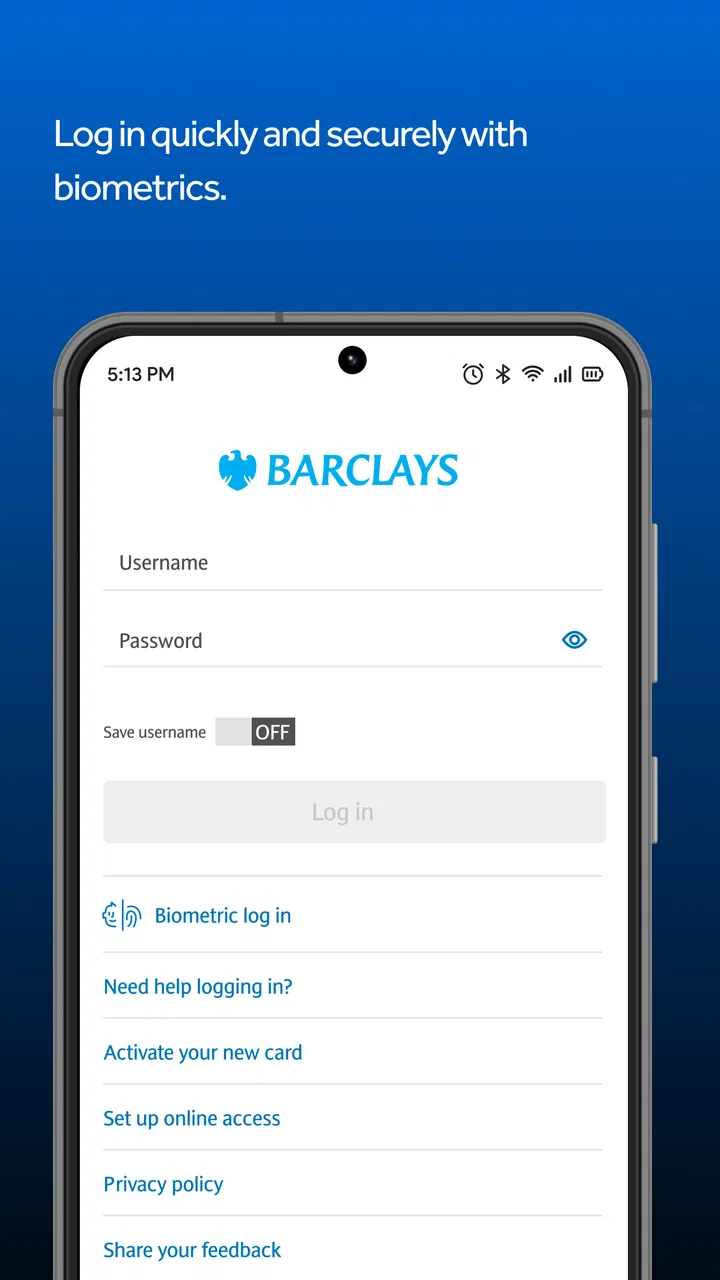
Yes, the Barclays US app is built with robust security measures to protect your financial information. It uses encryption, biometric authentication (such as fingerprint and facial recognition), and a secure login process to ensure that your data remains confidential. Regular updates are also made to address any potential security vulnerabilities.
03Can I make payments through the Barclays US app?
Absolutely, the app allows you to make payments easily and securely. You can pay your credit card bill directly through the app, set up automatic payments, and even schedule future payments. Additionally, the app supports transferring funds between accounts, providing a seamless payment experience for users.
04Is there customer support available through the app?
Yes, the Barclays US app includes customer support features to assist users with any queries or issues. You can access a comprehensive FAQ section, engage with a virtual assistant for quick answers, or connect with a customer service representative for more detailed assistance. The app also provides contact information for direct communication.
05Are there any fees associated with using the Barclays US app?
The Barclays US app itself is free to download and use. However, standard fees associated with your Barclays account, such as transfer fees or penalties, may still apply when conducting transactions through the app. It's advisable to review the terms and conditions or contact Barclays customer service for detailed fee information.
Pros
- User-friendly interface simplifies navigation.
- Robust security features protect your data.
- Quick access to account balances and transactions.
- Seamless integration with other financial tools.
- Customizable alerts for account activities.
Cons
- Limited features compared to desktop version.
- Occasional login issues reported by users.
- No option for live chat support.
- Some features require additional authorization.
- App updates can be slow to roll out.

Barclays US
Gallery